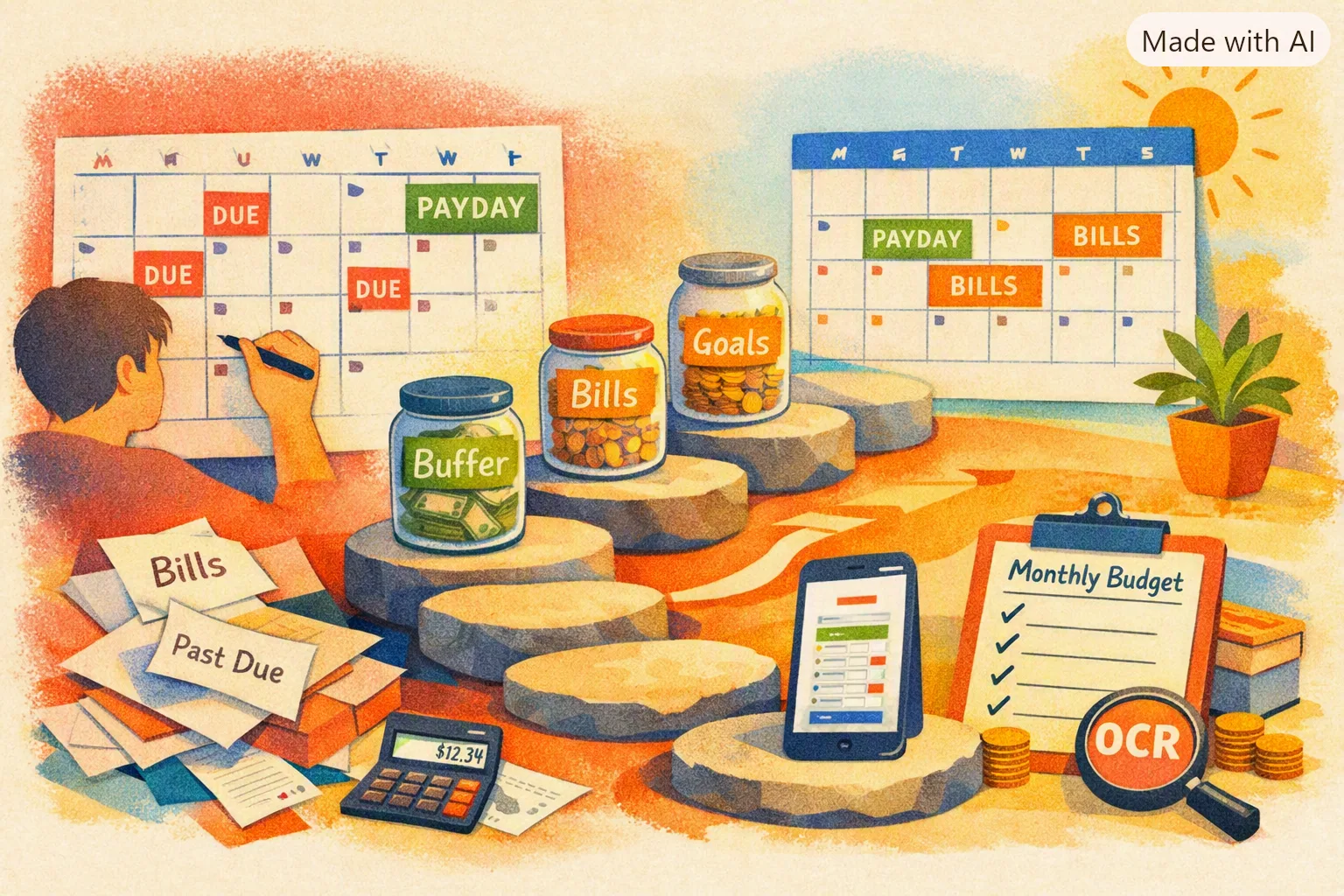
How to Stop Living Paycheck to Paycheck: A Step-by-Step System

Living paycheck to paycheck is not always an income problem — often it is a timing, visibility, or irregular-expense problem. Here is how to diagnose which one you have and build a system that actually works.

Yulia Lit

Yulia Lit

Consumer Psychology & Behavioral Economics Researcher

14 min read
Personal FinanceBudgetingBehavioral Finance#how to stop living paycheck to paycheck#paycheck to paycheck cycle#break living paycheck to paycheck#financial stability tips#paycheck budgeting#money management beginner
How to Stop Living Paycheck to Paycheck: A Step-by-Step System

How to Stop Living Paycheck to Paycheck: A Step-by-Step System

In 2026, approximately 61% of American adults live paycheck to paycheck, according to LendingClub's Annual Report on American Finances. That figure includes people earning more than $100,000 annually. The problem is not exclusively income. It is also structure.

Living paycheck to paycheck means your account balance approaches zero before your next income arrives. The stress is real — not just emotionally but neurologically. Research from the Wharton School of Business shows that financial scarcity occupies significant cognitive bandwidth, reducing available mental capacity for other decisions. The cycle self-perpetuates: financial stress impairs the planning ability you need to escape financial stress.

Breaking the cycle requires diagnosing its actual cause before applying a solution. The mistake most financial advice makes is offering universal fixes to a problem that has several distinct root causes with different solutions.

Key Takeaways

  • The paycheck-to-paycheck cycle has 4 distinct root causes — income too low for fixed expenses, spending too high relative to income, irregular/lumpy expenses not smoothed, and no buffer for genuine surprises — each requiring a different intervention
  • Visibility comes before control — you cannot realistically change what you cannot see; expense tracking is prerequisite, not optional
  • The first financial milestone that breaks the cycle is $1,000–$1,500 in a buffer account, not an elaborate budget
  • Irregular expenses (insurance, annual subscriptions, car maintenance, gifts) are the most commonly missed budget category and the most reliably disruptive
  • Automating savings before spending is the highest-leverage behavioral change available — higher than any budgeting system

Step Zero: Diagnose Your Root Cause

Most paycheck-to-paycheck advice jumps directly to solutions. But the solution for "I make $42,000 and my fixed expenses are $3,800/month" is completely different from "I make $85,000 but I cannot account for where $2,200/month goes."

Diagnosis quiz

Why Are You Living Paycheck to Paycheck?

Answer 2–3 questions to identify your specific root cause — and the matching fix.

Even in months when you consciously restrict spending, does your balance still approach zero?

Root Cause 1: Income Is Genuinely Insufficient for Fixed Costs

This is the hardest version of the problem because no budgeting advice resolves it. If your minimum required expenditures (rent, utilities, food, transportation, minimum debt payments) consume your entire income, there is no behavioral trick that creates surplus.

Signs: Your account is near zero even in months when you consciously restrict spending. You have identified no major discretionary categories to cut. You have already eliminated obvious waste.

Primary lever: Income increase — side work, overtime, job change, negotiation, housing adjustment (housing is usually the highest-impact variable). Secondary lever: debt restructuring (consolidation to lower minimum payment), not lifestyle adjustment.

Root Cause 2: Spending Exceeds Income in Discretionary Categories

More common than Root Cause 1 for middle-income earners. Total income would be sufficient if discretionary spending (dining, entertainment, subscriptions, impulse purchases) were better controlled — but comprehensive tracking reveals the distribution is misaligned with stated priorities.

Signs: You are frequently surprised by your bank balance. You know roughly what you earn but cannot accurately state what you spend in major categories. The month's spending feels reasonable in aggregate but the account balance contradicts this.

Primary lever: Visibility first. Accountability second. Most people in this category do not have an accurate baseline of current spending, which makes any target arbitrary.

Root Cause 3: Irregular Expenses Arrive as Surprises

The most technically solvable version of the problem — and the most underappreciated. Annual and semi-annual expenses (car insurance, property tax, annual subscriptions, car registration, holiday gift budgets, quarterly utilities) are predictable but infrequent. When they arrive inside a regular monthly budget, they appear to be crises but are actually scheduling problems.

Signs: You manage your monthly budget reasonably but specific months are consistently difficult. You have "good months" and "bad months" with no obvious pattern. You regularly find yourself saying "I forgot that was coming."

Primary lever: Irregular expense smoothing — calculating annualized costs of all irregular expenses, dividing by 12, and treating this monthly figure as a fixed expense line in every budget.

Root Cause 4: No Margin for Genuine Surprises

A structural buffer problem. Income covers all normal expenses including irregular ones accounted for appropriately — but any deviation from the expected (car repair, medical bill, appliance replacement, job gap) immediately causes crisis because there is nothing between "normal" and "overdrawn."

Signs: You feel financially stable for months at a time but a single unexpected expense derails everything. You have managed to match income and expenses but have no cash reserves.

Primary lever: Buffer account — even a small one. The first $1,000–$1,500 of surplus going somewhere that is not current spending creates meaningful stabilization.

Information

Research from the Consumer Financial Protection Bureau found that households experiencing financial fragility typically show overlapping contributors — often Root Causes 2, 3, and 4 simultaneously. Solving one while ignoring the others only partially stabilizes the system. This is why interventions that address only spending discipline (Root Cause 2) often fail — irregular expenses (Root Cause 3) or lack of buffer (Root Cause 4) continue to cause crises.


The Five-Step System

Step 1: Establish Full Spending Visibility (Week 1–2)

You cannot target spending you cannot see. Before any other intervention, you need an accurate picture of where your money actually goes — not where you think it goes.

The common mistake: Estimating from memory. Research from Harvard Business Review on consumer self-reporting consistently shows people underestimate discretionary spending by 20–40%. Your mental accounting is systematically biased toward recalling planned purchases (rent, subscription fees) and systematically biased against recalling discretionary micro-purchases (coffee, convenience stores, spontaneous online orders).

What to do instead: Track every transaction for 30 days with receipts. Every one. Cash included. The discipline required is temporary — you are building a baseline, not a permanent behavior.

Tools: Receipt scanning apps (Yomio captures both the merchant and what you bought, enabling category breakdown at item level rather than store level), bank statement downloads into a spreadsheet, or manual logging. Method matters less than consistency.

The practical output is a category breakdown of your actual spending for one full month. This is the baseline against which any change is measured.

Step 2: Map Your Actual Annual Expenses (Week 2)

Take your 30-day baseline and extend it. Pull all annual, quarterly, and semi-annual expenses from:

  • Last year's bank and credit card statements
  • Your email inbox (subscription receipts, renewal notices)
  • Your home files (insurance documents, registration receipts)

Create a list of every predictable non-monthly expense. Calculate the monthly equivalent (annual cost ÷ 12).

Common categories people miss:

  • Auto insurance (usually semi-annual: $400–$900 payment arrives and seems like a surprise)
  • Property tax or renter's insurance
  • Annual software and media subscriptions (Spotify, iCloud, Adobe, etc.)
  • Car maintenance reserve (for predictably unpredictable maintenance: oil changes, tires, brakes)
  • Medical and dental insurance deductibles
  • Travel and gifts (annual holiday budget, birthday gifts — not random, just infrequent)

Add the monthly equivalents of all these to your fixed monthly expenses. For many people, this adds $200–$600/month to their effective monthly required spending — which immediately explains why "bad months" reliably occur.

Warning

Most people, when they complete Step 2, discover that their actual monthly required budget is 15–30% higher than their mental model of monthly expenses. This is not a failure of discipline — it is a failure of accounting visibility. Once the irregular expenses are correctly amortized into the monthly view, the budget problem often becomes more solvable: you are now working with accurate numbers.

Step 3: Build a Small Buffer Before Anything Else (Week 3–6)

The advice to save 3–6 months of expenses before doing anything else is counterproductive for people in the paycheck-to-paycheck cycle. That goal is so distant it is demotivating. The correct first milestone is $1,000–$1,500 in a separate account that is not easily accessible for routine spending.

This is not an emergency fund (see our guide to building an emergency fund for that). This is a psychological and financial buffer — a circuit breaker that prevents a single unplanned expense from causing overdraft fees, credit card charges, or crisis behavior.

Why $1,000–$1,500 specifically: This range covers the most common single-event financial disruptions: minor car repairs, one month's increased utility bills, a medical co-pay, a broken appliance replacement, or a missed shift's worth of income. Below this threshold, each disruption penetrates all the way to zero. Above this threshold, most routine disruptions are absorbed without cascading to crisis.

Where to put it: A separate savings account at a different bank from your checking account. Different bank matters — it removes the one-tap transfer temptation. High-yield savings accounts (commonly 4–4.5% APY in 2026) generate real return on this buffer. The account should require 1–2 days' transfer time to access; fast enough for real emergencies, slow enough to prevent casual raiding.

How to fund it: Temporarily, from the highest-discretionary spending category identified in Step 1. The target is 8–12 weeks to accumulate $1,000–$1,500, which requires a temporarily reduced but not eliminated discretionary budget.

Step 4: Automate the Distribution of Each Paycheck (Ongoing)

Manual budgeting fails because it requires a decision at the moment of spending. Automated allocation removes the decision by distributing money before it is available to spend.

The basic structure:

  1. Paycheck arrives in checking account
  2. Fixed expenses auto-draft (rent, utilities, loan payments) — these are already automated for most people
  3. On payday (or within 24 hours), an automatic transfer moves:
    • 15–20% to savings (buffer first, then emergency fund, then long-term)
    • Monthly equivalent of irregular expenses to a "sinking funds" savings account (this accumulates until the irregular expense arrives)
  4. Remaining balance is "available to spend" — no mental overhead required

The key insight: When the sinking funds and savings transfers happen before any discretionary spending, the account balance you see is the amount available to spend. This eliminates the cognitive task of tracking how much is "reserved" in your head — a reservation that fails silently when you are tired, distracted, or stressed.

Step 5: Review and Adjust Monthly (30 minutes/month)

The system described above is not self-tuning. Incomes change. Expenses change. The irregular expense list needs annual updating. Automation settings need occasional review.

The review should be simple: Did the sinking funds cover their intended expenses this month? Did any new irregular expenses appear that need to be added to the monthly transfer? Is the account balance following a predictable pattern, or are there consistent withdrawal patterns suggesting a category was missed?

Monthly reviews take 30 minutes once the system is established. The absence of reviews causes systems to drift until a new crisis forces attention — and crisis-driven financial decisions are statistically worse than proactive ones.

See exactly where your paycheck goes — at item level

Yomio tracks spending from receipts, capturing not just amounts but what you bought. Find the discretionary spending you currently cannot see. Free to start.

Start tracking with Yomio

The Income Shortfall Case: When the System Isn't Enough

Everything above assumes that income, properly allocated, can cover expenses with some surplus. For households where it genuinely cannot — where Root Cause 1 applies — the system above is insufficient as a standalone solution.

In this case, the variable to solve is income or fixed expense structure:

Income levers:

  • Gig and side income (median US side hustler earns $483/month per Bankrate 2025 data)
  • Career income growth (raises, promotions, job changes — the highest-leverage variable for long-term trajectory)
  • Conversion of a skills asset to direct income (freelance, consulting using professional skills)

Fixed expense levers:

  • Housing relocation (rent is typically the highest-leverage single line item)
  • Car restructuring (costly car payments combined with insurance can be replaced with cheaper transportation)
  • Debt consolidation (reducing minimum payment requirements through refinancing)

Success

A 2023 study from the Financial Health Network found that households who reduced paycheck-to-paycheck stress through even partial buffer accumulation ($500+) showed measurable improvements in credit scores, debt repayment rates, and savings behavior 12 months later — independent of income changes. The psychological effect of having any buffer is self-reinforcing over time.


Common Mistakes That Keep People in the Cycle

Mistake 1: Saving what's left rather than spending what's left after saving. The sequence matters. Automated savings at paycheck arrival transfers the mental model from "save what I don't spend" to "spend what I haven't saved." The outcomes are dramatically different.

Mistake 2: Perfect being the enemy of good. A $400 buffer is not $1,000, but it is better than no buffer. A budget that covers 80% of expenses is better than no budget because the remaining 20% is hard to predict. Progress on imperfect systems beats paralysis waiting for perfect conditions.

Mistake 3: Solving the wrong root cause. Applying spending discipline to an income problem does not fix the income problem. Applying budgeting tools to an irregular expense problem does not fix the irregular expense problem until those expenses are correctly accounted for in the budget. Diagnosis before intervention improves outcomes significantly.

Mistake 4: No tracking during the change period. Behavioral change without measurement is anecdote. If you do not track whether the system is working, you cannot identify whether the interventions are having the intended effect — which means you cannot course-correct when they're not.

Mistake 5: Conflating sinking funds with emergency funds. Sinking funds are for known irregular expenses (scheduled, predictable). Emergency funds are for genuinely unexpected, unpredictable events. They serve different functions and should not cannibalize each other.


How Long Does It Take?

There is no universal timeline, but realistic benchmarks based on LendingClub and CFPB data for households making focused changes:

MilestoneRealistic Timeline
Full spending visibility baseline30–60 days
$1,000 buffer account funded8–16 weeks (at $100–$125/week redirected)
Irregular expenses fully mapped and smoothed90 days
First month where paycheck does not reach zeroWithin 3–6 months
$3,000–$5,000 emergency fund12–18 months

These timelines assume income above genuine minimum threshold. They are not guaranteed and depend significantly on Income vs. Expense gap.


Frequently Asked Questions

I've tried budgeting many times. Why will this be different? Most budgeting attempts fail because they start with targets rather than baselines, skip irregular expense mapping (meaning the budget immediately encounters surprise expenses it was not designed for), and rely on manual discipline without automation. The system above addresses each of these failures specifically. If your previous attempts failed, we would guess at least one of these three mechanisms was absent.

Should I pay off debt or build a buffer first? Build the $1,000 buffer first. This is counterintuitive if the debt is carrying interest. The reason: without any buffer, the next financial disruption adds more debt, wiping out any debt paydown progress. A small buffer breaks this cycle. After $1,000 is in place, redirect surplus to the highest-interest debt using the avalanche method (highest rate first).

What if my income is irregular (freelance, gig work)? Irregular income makes the system more important, not less. The modification: base your monthly expense budget on 70–80% of your average monthly income over the last 12 months. In high-income months, direct the surplus to buffer and sinking funds rather than discretionary spending. This smooths the income volatility that irregular earners experience.

How do I track item-level spending without spending hours every day? Receipt scanning is the lowest-friction approach. Scanning a receipt immediately after a purchase takes 5–10 seconds and captures both the merchant and what you bought, automatically categorized. Apps like Yomio do this with a phone camera without requiring manual entry. For card transactions where you do not have a receipt, a simple daily 60-second log of any unreceipted cash spending is usually sufficient.