How to Track Expenses for Taxes: The Complete 2026 Guide
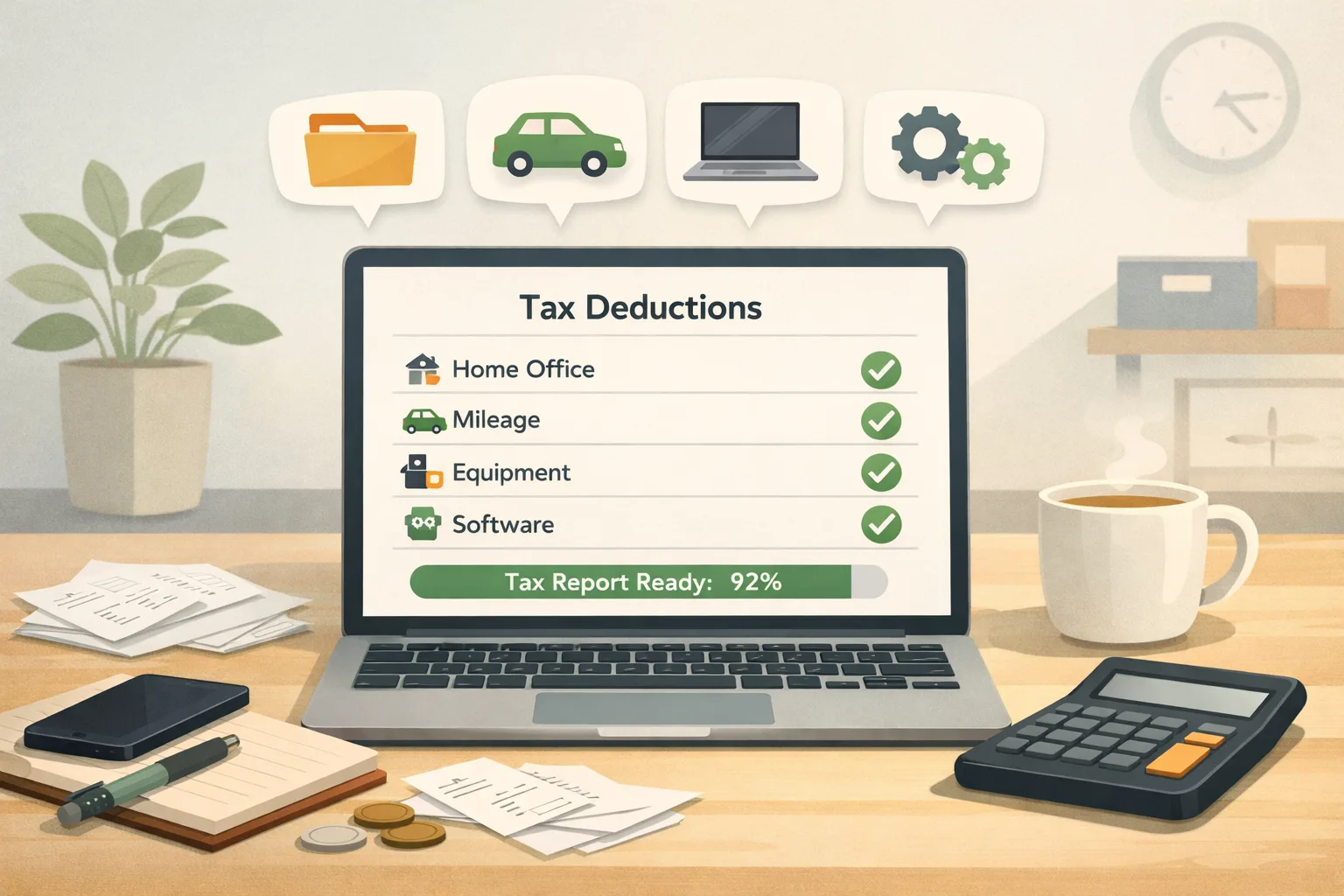
Track tax-deductible expenses all year so tax season is a report, not a search. Home office, mileage, equipment, and software — organized before April.

Yulia Lit
Consumer Psychology & Behavioral Economics Researcher
How to Track Expenses for Taxes: The Complete 2026 Guide
To make tax preparation easier, record each business expense when it happens, save its supporting documents, and note its business purpose. Review the records regularly so you can give complete information to your tax preparer or use it when preparing your return.
This guide explains common expense categories and a simple recordkeeping workflow. Whether a cost is deductible depends on your work, the expense, and current tax rules; this is general information, not individualized tax advice.
Key Takeaways
- Common expenses that may qualify include business use of a home or vehicle, insurance, and retirement-plan contributions; eligibility and records depend on the rules for each deduction
- For 2026, the IRS business mileage rate is 72.5 cents per mile from January 1 through June 30, and 76 cents per mile from July 1 through December 31; use the rate for the date of each trip (IRS rates)
- Record expenses close to when they happen and keep receipts, statements, logs, and notes that support the business purpose; the exact proof needed depends on the expense (IRS recordkeeping guidance)
- A deduction reduces taxable income, not tax by a fixed amount; the effect depends on the taxpayer’s full return and applicable limits
- HSA and FSA rules differ, and eligibility depends on the plan and individual circumstances; check current IRS guidance before claiming a tax benefit
Why Expense Tracking for Taxes Is Different From Regular Budgeting
Regular expense tracking tells you what you spent. Tax expense tracking tells you what you spent that reduces your taxable income. The two overlap but are not the same — and confusing them is how people miss deductions.
A restaurant meal is not deductible just because you discuss business during it. A meal may qualify only when it meets the applicable business-purpose and substantiation rules; generally, the taxpayer or an employee must be present, and the expense cannot be lavish or extravagant. The usual deduction limit is 50% of the otherwise allowable amount, subject to exceptions. Keep records of the amount, date, place, business purpose, and attendees when required, and check IRS Publication 463 before claiming a deduction.
The three requirements for any business expense deduction:
- Ordinary: The expense is common and accepted in your trade or business
- Necessary: The expense is helpful and appropriate for your trade or business
- Documented: You have a receipt, invoice, or contemporaneous record proving it
Keep records that help show the amount, date, payee, and business purpose of an expense. IRS recordkeeping rules vary by expense category, so keep the source documents and a short explanation rather than relying on a single universal checklist.
Warning
An account statement can help show that you paid a cost, but it may not explain what you bought or why it was for business. Keep receipts or invoices and add a note or log when needed to show the expense’s business purpose. The IRS says records made at or near the time of an expense are generally more useful than records recreated later (IRS Publication 463).
The 9 Expense Categories to Track Year-Round
1. Home Office
For U.S. federal taxes, a qualifying self-employed person may deduct eligible home-office costs if the space meets IRS business-use tests; working remotely as a W-2 employee generally does not qualify for an unreimbursed home-office deduction. See the IRS home-office guidance before claiming any amount.
Simplified method: generally $5 per square foot for the tax year, up to 300 sq ft ($1,500 maximum before eligibility and income limits). The simplified method does not include a home depreciation deduction for the year it is used.
Regular method: allocate eligible actual home expenses under IRS rules. The calculation depends on the cost, the business-use area, and other facts; it is not always larger than the simplified method.
What to document: Floor plan measurements, total home square footage, statements for costs included in the calculation, and the method used to allocate shared expenses.
2. Business Mileage
Eligible business miles may be claimed using the standard mileage method when IRS rules allow. Keep a log and verify that the trip and method qualify.
2026 rates: 72.5 cents per business mile for trips from January 1 through June 30, and 76 cents per mile for trips from July 1 through December 31. The standard rate includes vehicle operating costs, so you generally do not also deduct those same costs separately; qualifying parking and tolls may be deductible separately.
What to document: A mileage log with date, destination, business purpose, and miles for each trip, plus other records required for your method. Yomio organizes receipt records; it does not track mileage.
Tip
Travel from home to a regular workplace is generally commuting. If your home qualifies as your principal place of business, travel from that home office to another work location in the same business may qualify; simply making a client visit your first stop does not by itself turn a commute into business mileage. See IRS Publication 463 for the rules and exceptions.
3–9. Other High-Value Categories
Record categories as bookkeeping labels, not as a decision that a cost is deductible. Common records to organize include supplies, equipment, insurance, professional fees, software, and eligible vehicle or home-office costs. The IRS explains current U.S. business recordkeeping in Publication 583; each deduction has its own eligibility and substantiation rules.
U.S. federal recordkeeping only
Organize records for review
Choose records you want to gather. This checklist does not decide whether an expense is deductible or reportable.
Select records to gather:
Select at least one record type.
How to Track Expenses for Taxes: 4 System Options
Option 1: Dedicated expense tracking app (recommended)
The most reliable system is an app that captures receipts at point of purchase and assigns a tax category automatically. Yomio's receipt scanner extracts the merchant, amount, date, and line items from any paper or digital receipt — and you can tag any expense as a business category.
At tax time, export a CSV filtered by business category. Every line item is documented with a receipt image. The export goes directly to your accountant or into tax software.
Time cost: 30 seconds per receipt at time of expense. Zero time at year-end reconstruction.
Option 2: Dedicated bank account + credit card for business
Open a separate checking account and credit card used exclusively for business expenses. At year-end, download the statement — every transaction is a business expense by definition.
Limitation: Does not capture cash transactions, does not auto-categorize by deduction type, and does not store receipt images (needed for audit documentation).
Option 3: Email folder system
Forward all digital receipts to a dedicated email folder tagged "business expenses 2026." Label each email with the category (home-office, software, meals) at time of filing.
Time cost: Low per receipt. High at year-end when you reconstruct categories.
Option 4: Envelope + spreadsheet
Physical receipts go in a dated envelope by month. A spreadsheet row is added for each receipt with amount, category, and description.
Best for: People with very few business expenses (< $500/month) and no need for audit documentation beyond the receipts themselves.
Setting Up a Weekly 10-Minute Tax Review
Regular reviews can make it easier to spot uncategorized transactions and missing receipts while details are still available. Choose a schedule that works for your business; a weekly review is one option:
The weekly tax review process (10 minutes):
- Open your expense tracker or bank statement from the past 7 days
- Tag any uncategorized expense as business or personal
- For business expenses, add a note: who, what business purpose, project name if applicable
- Confirm any receipts were captured (photo, email forward, or automatic scan)
- Note any mileage from the week not yet logged
This routine does not determine whether an expense is deductible. Use it to keep an organized record for later review.
Success
Self-employed people may need to make estimated tax payments, but the requirement depends on expected tax, withholding, credits, and prior-year tax. In general, estimated payments are required when you expect to owe at least $1,000 after withholding and refundable credits and expect withholding and credits to be less than the smaller of 90% of current-year tax or 100% of prior-year tax; a 110% prior-year threshold applies to some higher-income taxpayers. The general 2026 due dates are April 15, June 15, and September 15, 2026, and January 15, 2027. Special rules and exceptions apply, so check IRS Publication 505 or a qualified tax professional. Expense records can help you estimate business income and costs, but a deduction does not reduce tax by a fixed percentage.
The Home Office Deduction: Check the Eligibility Rules
If you use part of your home for business, check whether you meet the IRS eligibility rules before claiming a deduction. The simplified method generally uses $5 per square foot, up to 300 square feet, subject to eligibility and income limits; the regular method allocates qualifying actual home expenses. See the IRS home-office deduction guidance for the rules and method comparison.
The qualifying test is stricter than most people assume:
- The space must be used regularly (not occasionally) for business
- It must be used exclusively for business — a bedroom with a desk used for both personal Netflix and work calls does not qualify
- A dedicated room, portion of a room consistently used only for work, or a separate structure all qualify
The deduction amount varies with the eligible area, method, qualifying costs, business income, and other limits. A deduction reduces taxable income; it does not produce the same tax savings for every person.
Keep expense records ready for review
Capture receipts and organize expense details in Yomio. Confirm current tax treatment and recordkeeping rules with the IRS or a qualified tax professional.
Explore YomioMore from Yomio
- Track business expenses as a freelancer — the complete freelancer tax setup guide
- Side hustle expense tracker — track income and deductions for your secondary income
- Automatic expense categorization — how AI assigns categories to your receipts
- Best expense tracking apps — app comparison for self-employed workers