Spending Limits by Category: How to Set Your Own Numbers
Set practical category spending limits from your own records, cash flow, and priorities. Use national averages as context, not personal rules.

Andrei Popescu
FinTech Product Analyst & Personal Finance Technologist
Spending Limits by Category: How to Set Your Own Numbers
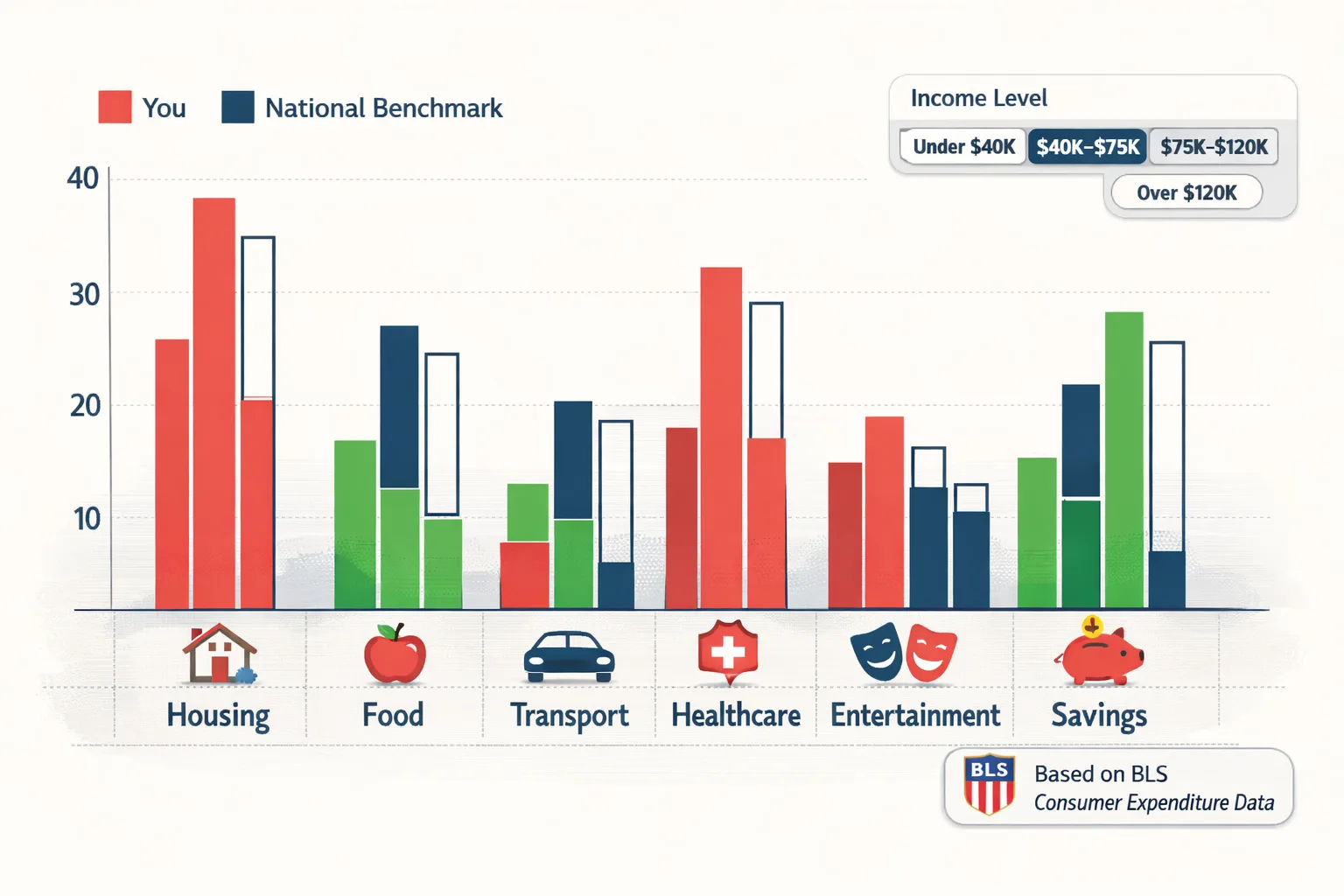
Set each spending limit from your recent expenses, take-home income, and priorities. National averages describe what surveyed households spent; they do not tell you what you should spend. For U.S. context, the latest annual tables currently published by the Bureau of Labor Statistics (BLS) report 2024 consumer expenditure data, including differences by income and household characteristics.
Step 1: Choose categories that answer a real question
Start with a short list you can review each month. Common categories include housing, utilities, food at home, food away from home, transportation, health care, debt payments, savings, and discretionary purchases. Separate a category only when knowing its total would help you make a decision.
For example, you might split groceries from restaurant and delivery spending if you are comparing those choices. You may keep electricity and water together if you only need to know the total for household utilities.
Step 2: Use your own records as the starting point
Review one to three recent months of bills, receipts, account records, or other tracking data. Include irregular costs that do not arrive monthly, such as insurance renewals, repairs, school costs, and annual subscriptions. For a predictable yearly bill, divide the expected amount by 12 and set it aside each month if that fits your cash flow.
Do not treat an unusually expensive month as your normal baseline without checking why it was different. Seasonal travel, a medical bill, or a move may make one period unrepresentative.
Step 3: Check the plan against money available
Use take-home income if you are planning day-to-day spending from paychecks. List fixed bills, minimum debt payments, and planned savings first. The remaining amount is what you can assign to flexible categories.
If the categories add up to more than the money available, the plan is a signal to revisit amounts or priorities. Changing a number in a worksheet does not create additional income, and a benchmark percentage cannot resolve a shortfall by itself.
Step 4: Set a limit and decide when to review it
Choose a limit you can explain and revisit. For a category with frequent purchases, check it weekly or after larger transactions. For fixed bills, a monthly review may be enough. If actual spending is consistently higher than the limit, update the plan or decide what change is realistic instead of repeatedly carrying an unusable number forward.
Keep the rule simple:
- Record the category's actual spending.
- Compare it with your plan.
- Identify the reason for a difference.
- Adjust the limit or make a specific change for the next period.
What national spending data can and cannot tell you
The BLS Consumer Expenditure Survey collects information about U.S. consumer units and publishes averages and tables by selected characteristics. For example, its 2024 release reported average annual total expenditures of $78,535 per consumer unit. That figure is an aggregate average, not a recommended household budget, and an average does not describe every household. The BLS release and tables provide more detail and explain the survey data.
Compare like with like when you use the tables. Household size, income, age, location, and the categories included in a table can change the comparison. Some detailed estimates have high variance or may be suppressed when BLS considers them unreliable; read the table notes before using a figure.
Use the survey to ask better questions, such as whether your spending is in the same broad range as a relevant group. Use your own budget and goals to decide what amount is workable for you.
Common mistakes
Copying a percentage without checking your fixed costs
Rules such as 50/30/20 can be a starting point for discussion. They may not fit every income, housing market, household, or financial obligation. Treat a percentage as a prompt to review your plan, not a test you have passed or failed.
Making the first limit an aspiration instead of a plan
If your planned amount is far below your recent spending, identify what will change before relying on that number. If nothing changes, use actual expenses to reset the estimate and choose a smaller step that you can monitor.
Ignoring infrequent purchases
Repairs, gifts, fees, and annual bills still use money even if they do not appear every month. Include them in a periodic-cost category or plan for them separately.
Comparing without context
Spending above an average is not proof of waste, and spending below it is not automatically a success. Consider what the category includes and whether the amount supports the rest of your plan.
Insight
A national average can help you ask whether a category deserves a closer look, but it does not set a suitable limit for your household. Compare the table's population and category definitions with your own situation before drawing a conclusion.
Tip
Check recurring charges when you review your plan or before a renewal. Confirm who uses each service, what the current plan includes, and how cancellation works before you change it.
Insight
A category can reflect something that matters to you, such as meals with friends or travel. When a limit feels difficult to use, ask whether it fits your priorities and available income before changing it.
User-entered comparison
Compare your own spending with your own income
Choose a time period and enter income and category amounts in the same currency. This tool reports only your entered amounts and their shares.
Use the same currency for every amount. This tool does not convert currencies.
Review category spending from receipt records
Capture receipts or enter expenses manually, then compare the recorded purchases with the categories and limits in your own spending plan.
Explore YomioFAQ
How much should I spend on groceries?
There is no single amount for every person or household. Review recent food-at-home spending, household size, local prices, dietary needs, and the amount available after other priorities. Then choose a limit that you can check and update.
Should I use gross income or take-home income?
For a household spending plan built around paychecks, take-home income is often the practical starting point because taxes and payroll deductions have already been removed. If you have a different planning method, use it consistently and avoid comparing gross-income percentages with take-home-income percentages.
How often should I change spending limits?
Review limits when income, household needs, recurring bills, or priorities change. Otherwise, compare actual spending with the plan at a regular interval and adjust when the evidence shows that an amount no longer fits.
Does the BLS average tell me what I should spend?
No. It describes surveyed U.S. consumer spending. Your limit should reflect your own costs, available income, and goals.