How to Stop Online Shopping: A Behavioral System That Actually Works

Online shopping is designed to bypass your willpower. Here's how to counter-engineer the system — starting with identifying your trigger type.

Yulia Lit

Yulia Lit

Consumer Psychology & Behavioral Economics Researcher
12 min read
Behavioral FinancePersonal FinanceMoney Psychology#how to stop online shopping#stop impulse buying online#online shopping addiction#reduce online purchases#shopping habit break 2026
How to Stop Online Shopping: A Behavioral System That Actually Works

How to Stop Online Shopping: A Behavioral System That Actually Works

Online impulse purchases account for $18.5 billion in unplanned spending annually in the US — a 41% increase since 2021. This isn't a willpower problem. It's an engineering problem.

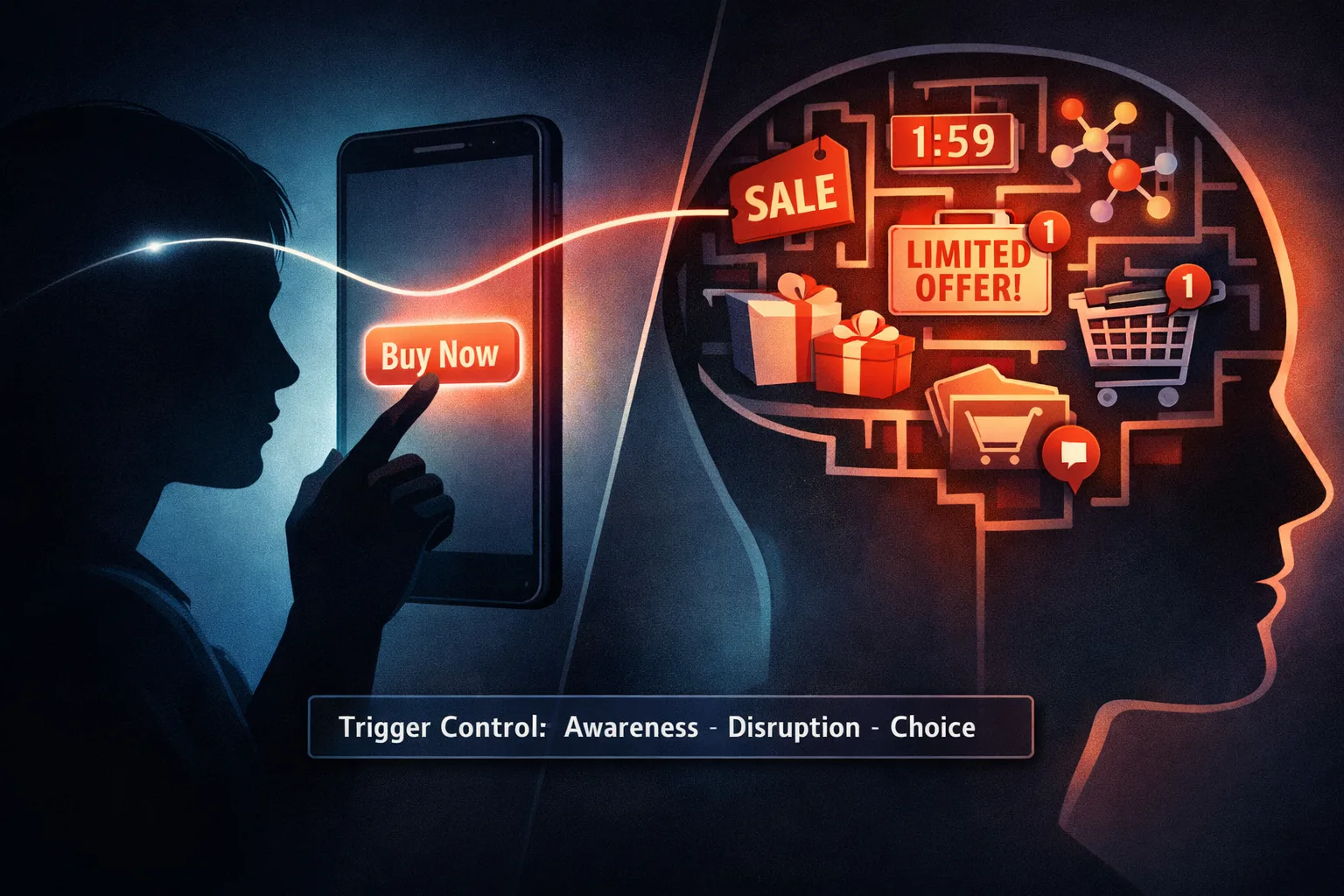
Amazon, Shein, TikTok Shop, and every other platform have spent billions of dollars optimizing their platforms to convert hesitation into purchase as quickly as possible. One-click buying removes friction. Saved payment information removes the "pain of paying." Urgency timers and low-stock warnings activate the fear of missing out. Personalized recommendations make sure the thing you almost bought last week reappears in your feed this week.

Telling someone to "have more willpower" in this environment is like telling someone not to get wet while swimming. The system is designed to win. You need to counter-engineer it — not out-discipline it.

Key Takeaways

  • Online shopping triggers fall into 5 types: boredom, stress, social FOMO, reward, and convenience
  • The counter-strategy depends on the trigger — generic advice fails because it doesn't address the root cause
  • Deleting saved payment information is the single highest-impact friction tactic
  • The 48-hour rule (add to cart, don't buy for 48 hours) eliminates the majority of impulse purchases
  • Tracking your online purchases in real time creates the awareness that changes the behavior
  • Most people significantly underestimate how much they spend online per month

Why Willpower Doesn't Work Here

Willpower is a finite resource that depletes over the course of a day. Online retail platforms are designed to catch you when it's lowest — late evening, during stress, during boredom. That's not a coincidence: engagement data shows purchase rates are highest between 9pm and 11pm, precisely when daily willpower is most depleted.

The dark patterns deployed by online retail to bypass decision-making include:

Urgency engineering: "Only 3 left in stock," "Sale ends in 2:47:33," "47 people are looking at this right now." These urgency signals are often fabricated or manipulated, but they activate the same fight-or-flight response as genuine scarcity. The result: you make a decision you'd reverse if given 10 minutes.

Friction removal: Saved payment information, one-click ordering, and pre-filled shipping addresses remove every step that would otherwise give you a moment to reconsider. The research is clear: every additional step in a checkout process reduces completion rates. Platforms optimize to eliminate those steps. You need to put them back.

Algorithmic FOMO: Recommendation engines don't show you things you'll love — they show you things you almost bought. The "Frequently Bought Together" and "Customers Also Viewed" sections aren't services. They're upsell mechanisms designed to increase average order value.

Social proof manipulation: Star ratings, review counts, and "X sold in the last 24 hours" badges exploit the psychological principle that other people's behavior is evidence of correct behavior. They're often gamed.

Warning

When asked to estimate their monthly online spending, most people guess $80–$120. When they pull actual transaction data, the real number is frequently $200–$350. The gap between perceived and actual online spending is one of the most consistent patterns in personal finance behavior research. This gap is what makes the problem hard to address — you're managing a number you don't actually know.

The 5 Online Shopping Trigger Types

The reason generic online shopping advice ("unsubscribe from promotional emails") has limited impact is that it treats all online shopping as the same behavior. It isn't. The trigger determines the mechanism, and the mechanism determines the effective counter-strategy.

1. Boredom Shopping
Trigger: Unoccupied time, usually in the evening. Browsing starts without intent. The shopping becomes the entertainment.
Pattern: High frequency, low individual amounts, very diverse categories — no consistent product type.
Underlying need: Stimulation and novelty.

2. Stress Shopping
Trigger: Anxiety, overwhelm, or frustration. Shopping activates a dopamine release that provides temporary relief from the stress state.
Pattern: Correlated with high-stress periods (work deadlines, relationship stress, financial stress). Higher individual purchase amounts than boredom shopping.
Underlying need: Control and relief.

3. Social FOMO Shopping
Trigger: Seeing others with a product (on social media, in real life, through influencer content). Fear of missing out on a trend, aesthetic, or experience.
Pattern: Category-specific (fashion, beauty, tech, home decor). Often follows a specific influencer recommendation or trending product.
Underlying need: Belonging and social identity.

4. Reward Shopping
Trigger: Using purchasing as self-reward after achieving something — finishing a project, completing a difficult week, hitting a milestone.
Pattern: Periodic spikes, often at predictable intervals. The "I deserve this" framing.
Underlying need: Recognition and celebration.

5. Convenience Shopping
Trigger: Friction in obtaining something offline. Online is simply faster, easier, or more available.
Pattern: Often justified — these are legitimate purchases made online for practical reasons. The problem occurs when convenience escalates into habitual browsing and overspend.
Underlying need: Efficiency.

Identify Your Trigger Type

Understanding which trigger (or combination) drives your online shopping is the starting point for a strategy that actually works for you:

Shopping Trigger Quiz

What Triggers Your Online Shopping?

Answer 6 quick questions. We'll identify your dominant spending trigger — and give you targeted strategies to break the pattern.

Question 1 of 60%

When do you most often open a shopping app or website?

Counter-Strategies by Trigger Type

For Boredom Shopping

The core intervention is replacement, not restriction. Boredom will find an outlet — you need to give it a better one than a shopping app.

The phone swap: Identify the 3 shopping apps you open when bored. Delete them from your phone's main screen. Replace their position with apps tied to the activity you'd rather do: a book app, a workout timer, a game, a podcast. The habit cue (reaching for your phone) stays — the destination changes.

The 48-hour cart rule: When you find yourself adding things to a cart while browsing, let the cart sit for 48 hours before purchasing anything from it. Research shows that 70–80% of items added to carts under boredom conditions are no longer desired 48 hours later. This isn't willpower — it's a structural delay that defeats the impulse's time window.

The "want/buy" list: Instead of immediate purchase, add desired items to a running list (a notes app works fine). Review the list monthly. Buy 1–2 items from it if they still appeal after time has passed. This converts impulsive boredom browsing into deliberate, infrequent purchasing.

For Stress Shopping

The core intervention is addressing the stress trigger directly rather than suppressing the shopping behavior.

The 15-minute rule: When you feel the urge to shop under stress, set a 15-minute timer and do something that addresses the stress state more directly: a short walk, 10 minutes of deep breathing, calling someone, writing down what's causing the stress. After 15 minutes, the acute urge has typically passed.

The spending journal: Keep a brief log of when you shop online and what you were feeling before you started. Even 1 sentence ("9pm, stressed about presentation tomorrow, opened Amazon"). After 2–3 weeks, patterns emerge that make the stress trigger visible — which is the first step to interrupting it.

Financial anxiety reframe: For many stress shoppers, the shopping itself generates guilt and financial anxiety that becomes a new stress trigger. Breaking this cycle requires recognizing that the purchase is borrowing future wellbeing to address present discomfort — and the debt always comes due.

For Social FOMO Shopping

The core intervention is feed curation and purchase delay.

The 30-day unfollow: For one month, unfollow every account that regularly makes you want to buy something. This includes influencer accounts, brand accounts, and "haul" accounts. The FOMO that drives social shopping requires continuous fuel — cut the fuel.

The question before purchase: When a social media recommendation drives a purchase impulse, ask: "Would I want this if I'd never seen it on anyone else?" This interrupts the social proof mechanism and forces the purchase to justify itself on its own merits.

The cost-per-use calculation: For trend items specifically, estimate cost-per-use: purchase price ÷ estimated number of times you'll actually use it. A $60 dress worn 1–2 times costs $30–$60 per use. The same calculation applied consistently recalibrates the perceived value of trend purchases.

For Reward Shopping

The core intervention is redesigning the reward system.

Non-purchase rewards: Build a personal reward menu of non-purchase rewards that activate the same feeling as shopping. These are highly personal — examples include a restaurant you love, a specific activity, an experience. The goal is to have an immediately available alternative to "buy something" when the reward trigger fires.

The savings milestone link: Tie "you deserve it" purchasing to a savings milestone rather than an achievement. Example: when your emergency fund hits $500, you have a $50 personal reward budget. This reframes the reward impulse into a savings incentive rather than a spending trigger.

Pre-authorized purchase: Budget a specific, fixed monthly amount for deliberate discretionary purchases. When it's spent, it's spent. This contains the reward shopping behavior within defined limits rather than trying to eliminate it — which typically fails.

For Convenience Shopping

The core intervention is reducing friction for legitimate purchases while increasing friction for habitual browsing.

The distinction test: Before every online purchase, apply a quick mental test: "Would I have bought this if I had to go to a store?" If yes — it's a genuine convenience purchase. If no — it's a convenience-enabled impulse.

Remove auto-complete checkout features: Keep delivery addresses saved (that's fine), but remove saved payment information. Entering your card number on each purchase takes 30–45 seconds. That friction is enough to stop a significant portion of low-consideration purchases.

Batch ordering: Instead of ordering from Amazon every time you think of something, keep a running list and place one order per week. Batching eliminates the delivery dopamine loop of daily small purchases and forces each item to survive until the weekly order window.

The 7 Universal Friction Tactics

Regardless of trigger type, these structural changes reduce online purchase frequency across the board:

1. Delete saved payment information from all shopping platforms.
This is the single highest-impact action. Research on payment friction shows that requiring manual card entry reduces impulse purchase completion by 20–30%.

2. Log out of shopping accounts on your browser.
Requiring a login adds a step and creates a micro-pause that catches a portion of mindless browsing before it converts.

3. Remove shopping apps from your phone's home screen.
Apps that require searching to find are used less than apps one tap away. Relocation (not deletion) is enough.

4. Use a browser extension for purchase delays.
Tools like PayPal Honey or dedicated "mindful shopping" extensions can enforce a configurable waiting period before checkout completes.

5. Unsubscribe from all promotional email lists.
Every promotional email is a generated purchase trigger. Use a service like Unroll.me or manually unsubscribe from every retail email list over the course of one week.

6. Pause all push notifications from shopping apps.
"Flash sale" and "back in stock" notifications are engineered purchase triggers. Disable all shopping app notifications at the system level.

7. Check your real monthly online spend before you open any shopping app.
If you know you spent $340 on online shopping last month — a number that surprised you — it creates cognitive friction before the browsing session begins.

Ready to Get Started?

Get Yomio on your phone and take control of your spending.

Get the App

How Spending Data Ends the Denial Loop

One of the most consistent observations in behavioral finance research is that people dramatically underestimate how much they spend online. This underestimation isn't deceptive — it's a genuine cognitive phenomenon called "purchase disaggregation": individual purchases feel small and unrelated, so the brain doesn't accumulate them into a mental total.

Seeing the real number breaks this. When Yomio's receipt and transaction tracking shows you spent $340 on Amazon last month — and your internal estimate was $80 — the gap becomes the motivation. Not guilt, but data.

This is why tracking is the foundational intervention, not a supplementary one. The specific tactics above all become more effective once you know your actual baseline. You're no longer managing a behavior you can only vaguely sense — you're managing a number you can see.

What to Do With the Money You Stop Spending

Stopping a spending behavior without redirecting the money rarely sticks. The money needs a destination that feels at least as satisfying as the purchase.

Make the savings visible: Create a named savings goal ("emergency fund," "Spain trip," "new laptop") and direct the money there explicitly. A savings goal with a label and a visible balance activates the same anticipation reward that shopping does — but it compounds rather than depletes.

Make the progress visible: Check the savings balance weekly. The growing number provides the same novelty signal that "adding to cart" provides. After 6–8 weeks, the savings habit competes with the spending habit for psychological real estate.

FAQs

Q: Is there such a thing as healthy online shopping?
Yes — online shopping for planned purchases (researched items, necessity purchases, considered gifts) is completely fine. The target behavior isn't zero online spending — it's intentional online spending where each purchase passed a genuine consideration test.

Q: I've tried the 48-hour rule before and I still buy things. Why?
The 48-hour rule reduces impulse purchases, not all online purchases. If you're still buying things after 48 hours, those may be genuine wants rather than impulses. The more interesting question is whether the accumulated total of those genuine wants fits within your discretionary budget.

Q: I use online shopping as a way to deal with anxiety. Is that wrong?
It's understandable, and very common. The issue isn't the coping behavior itself — it's whether the financial consequence of the behavior (debt, budget pressure) creates more anxiety than it relieves. If it does, the coping mechanism is causing the problem it's meant to solve. That's worth addressing directly, not just with friction tactics.

Q: What about subscriptions to services vs. physical product purchases?
Subscriptions deserve a separate audit. They're a distinct behavior pattern (see our subscription fatigue article) with their own tactics. The friction strategies here apply primarily to one-time product purchases.

Q: How long does it take to break an online shopping habit?
Habit research suggests 60–90 days of consistent counter-behavior to establish a new default pattern. The first 2 weeks are the highest-friction period. After 30 days, people typically report that the urge frequency has decreased even without active effort.

Take Control of Your Spending Today