Lifestyle Creep: Why Your Salary Keeps Growing But Your Savings Don't
Lifestyle creep silently absorbs every raise you've ever earned. Here's how to detect it in your own spending data — and how to stop it.
Yulia Lit
Consumer Psychology & Behavioral Economics Researcher
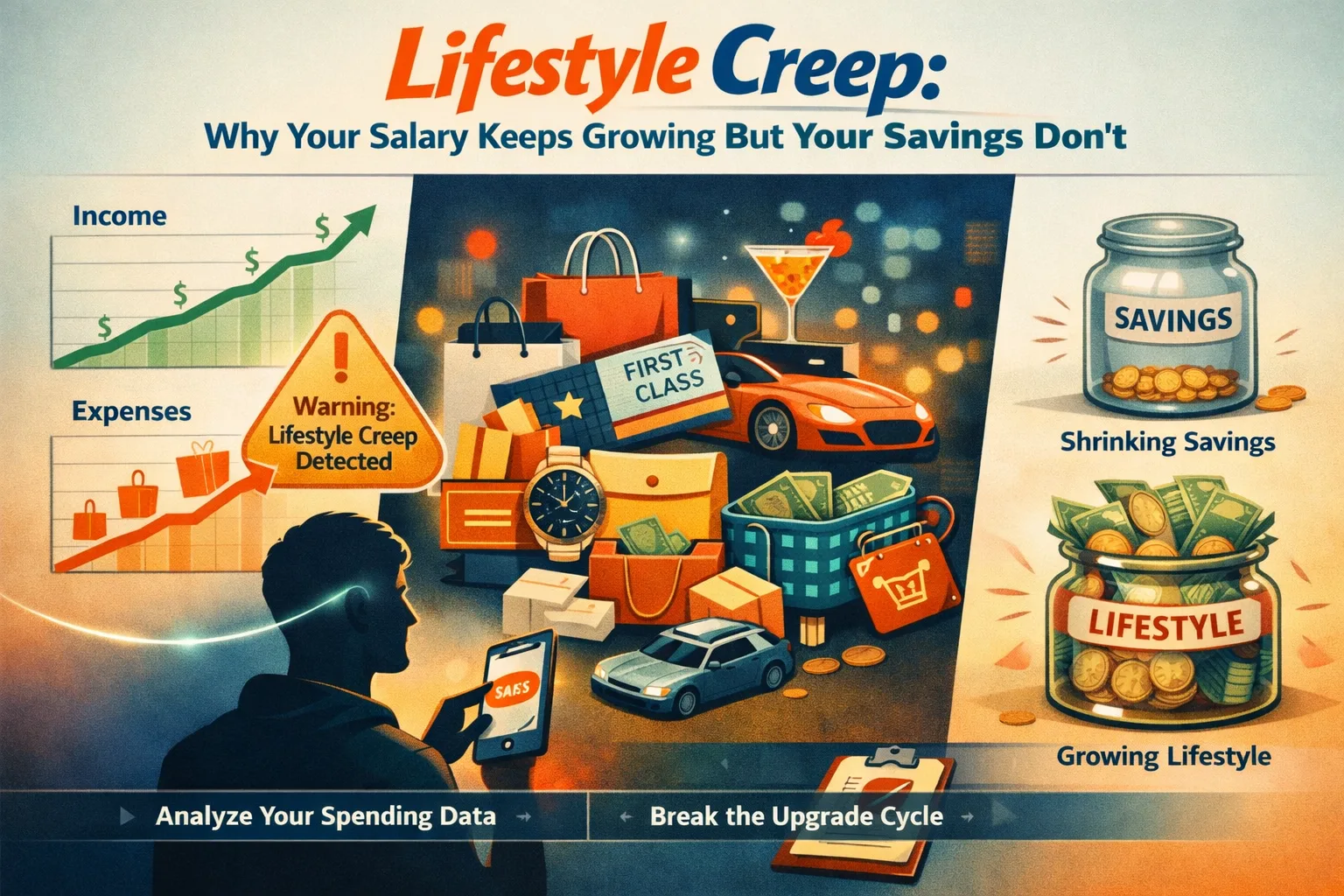
Lifestyle Creep: Why Your Salary Keeps Growing But Your Savings Don't
You earned 40% more than you did 5 years ago. So why does your bank account look the same?
You're not uniquely undisciplined. You're experiencing lifestyle creep — one of the most universally human financial patterns there is. Income rises. Spending rises to meet it. The margin disappears. And because it happens gradually, across dozens of small decisions, it's nearly invisible until you look back and realize your savings rate at $90,000/year is worse than it was at $55,000.
Understanding how this works — mechanically, psychologically, and in your own spending data — is the beginning of actually doing something about it.
Key Takeaways
- Lifestyle creep happens through three mechanisms: upgrade, addition, and social matching
- The raise illusion: after tax and lifestyle expansion, most people net $0 more per month from a 10% raise
- No single decision feels significant — the pattern only becomes visible in data over time
- A $500/month lifestyle inflation at age 28 vs. invested represents ~$120,000 less by age 38
- The counter is not frugality — it's deciding before a raise where the money is going
- Expense history is the only objective proof of lifestyle creep; gut estimates are unreliable
What Lifestyle Creep Actually Is
Lifestyle creep (also called lifestyle inflation) is the gradual, often unconscious process by which spending increases in proportion to income — leaving savings rate flat or declining even as earnings grow.
It's not the same as deliberately upgrading your standard of living. That's a conscious choice. Lifestyle creep is the version that happens without a decision, driven by availability ("I can afford it now") and social context ("this is what people at my income level do").
The pattern looks like this:
- Income increases (raise, promotion, new job, bonus)
- For a brief period — sometimes days, sometimes weeks — there's a surplus
- Small spending upgrades occur: a nicer gym, better coffee, a streaming service, a car upgrade, a solo apartment
- Each upgrade feels individually reasonable
- The surplus disappears
- Life doesn't feel materially better, because the reference point has also shifted
- Repeat when the next income increase arrives
After several cycles, you're earning significantly more and saving essentially the same percentage — or less — as when you started.
callout.insight
This is the most psychologically subtle aspect of lifestyle creep: not only does spending rise to meet income, but your perception of what's "normal" rises with it. The $12 lunch that felt like a splurge at 23 becomes the baseline at 28. The $25 Uber ride that was once a deliberate decision becomes the default. The reference point moves, so nothing ever feels like luxury — it just feels like standard life.
The 3 Mechanisms of Lifestyle Creep
Lifestyle creep doesn't work the same way for everyone. It operates through three distinct mechanisms, often simultaneously:
1. Upgrade Creep
The same product or service category, but a better version. Same behavior, higher price point.
Examples:
- $6 coffee → $12 specialty coffee
- Economy flights → premium economy or business
- Mid-tier gym → boutique fitness studio ($150/month vs. $30/month)
- Basic grocery store → Whole Foods
- Streaming 1 service → 5 streaming services
- Mid-range restaurant → upscale restaurant for the same "dinner out" occasion
Each upgrade is invisible because the category didn't change — just the price. Grocery shopping still feels like grocery shopping. Dinner out still feels like dinner out. The behavioral category is the same; the cost is 2–4× higher.
2. Addition Creep
New spending categories that simply didn't exist at a lower income level.
Examples:
- House cleaner (wasn't even considered at $45k, feels natural at $90k)
- Personal trainer
- Dog walker
- Monthly subscription boxes (meal kits, specialty coffee, clothing)
- Regular blowouts or grooming services
- A second car
- Regular first-class upgrades, checked baggage as default, TSA PreCheck
These feel particularly natural because they're described as "investing in yourself" or "buying back time." Sometimes they are. But they also represent a permanent increase in baseline spending that makes every subsequent income level require more to maintain.
3. Social Creep
Spending increases because your peer group's spending floor has risen with income.
Examples:
- Friend group changes from BYOB apartments to bar nights to bottle service
- Group dinners shift from casual restaurants to $70/head tasting menus
- Bachelorette parties go from a local dinner to a destination trip
- Birthday culture shifts from home gatherings to booked experiences
- Group travel escalates to 5-star properties
Social creep is particularly hard to resist because it comes with real social consequences. Opting out isn't just a budget decision — it's a social signal. The psychological pressure is genuine, which is why understanding this mechanism separately is important for addressing it honestly.
Detect Your Own Lifestyle Creep
How Much Has Lifestyle Creep Cost You?
Enter your income from 2 years ago and today, then select where your spending grew most.
The Compounding Cost: What Lifestyle Creep Actually Costs Over a Decade
Lifestyle creep feels affordable in the moment. The numbers over time tell a different story.
The scenario: At age 28, you receive a $15,000 raise. Instead of investing the after-tax portion (~$9,000/year, $750/month), it drifts into lifestyle upgrades: a nicer apartment ($250/month more), a car upgrade ($200/month more), upgraded dining and social spending ($150/month more), assorted subscriptions and conveniences ($100/month more). Total: $700/month in lifestyle expansion.
By age 38 (10 years later):
- $700/month × 12 months × 10 years = $84,000 in spending
- The same $700/month invested at 7% average annual return = ~$121,000
The gap: $121,000 less in assets than if the raise had been invested, not absorbed into lifestyle.
And this calculation covers only one raise. Most people experience 5–8 meaningful income increases over a decade, each with its own creep cycle.
Warning
A 10% raise sounds significant. After federal and state taxes, the actual take-home increase is roughly 6–7%. On a $70,000 salary, that's approximately $350/month more in take-home pay. If a new gym membership ($100), an upgraded apartment ($150), and some additional dining spending ($100) happen in the same period — the raise has been entirely absorbed before most people have consciously decided anything.
The Categories Where Lifestyle Creep Hides
Some expense categories absorb lifestyle creep more quietly than others. These are the ones most worth auditing when income has grown but savings feel flat:
Housing. The most financially significant lifestyle creep. Upgrading from roommates to solo living, or from a starter apartment to a premium one, often represents $300–$700/month in permanent fixed cost increase. Once signed, it's non-negotiable for the lease term.
Food and dining. The highest-frequency variable spending category. Upgrading from casual dining to upscale dining, from cooking at home to meal delivery, or from generic brands to premium grocery stores can add $200–$400/month invisibly across dozens of small decisions.
Transportation. Car upgrades are one of the most financially impactful forms of lifestyle creep. The difference between driving a $18,000 car and a $38,000 car translates to a payment difference of $300–$450/month plus higher insurance. The transportation experience is marginally better; the financial impact is significant.
Subscriptions and services. The most insidious form of lifestyle creep because individual amounts are small and recurring billing makes them invisible. Streaming services ($150–$200/month for 5–6 services), software subscriptions, membership services, convenience apps — these accumulate silently.
Personal care and health. Boutique fitness studios, regular grooming appointments, premium wellness products. This category grows with income in a way that feels particularly justified ("investing in health") but can represent $200–$400/month above a basic-but-adequate alternative.
How to Catch Lifestyle Creep Early
1. Do a Year-Over-Year Category Comparison
The only objective method is data. Compare what you spent per category 2 years ago vs. what you spend now. Not from memory — from actual records.
If you've been using an expense tracking app, pull category totals for the same 3-month period in each year. If you haven't, pull bank and card statements.
The categories where your spending has grown faster than inflation (roughly 3–4% per year) or faster than your explicit choices — those are where lifestyle creep is operating.
Yomio's analytics view shows category spending over time, making this comparison available without manual calculation. When you can see "Dining Out: $180/month in 2024 → $340/month in 2026," the creep is no longer invisible.
2. Apply the "Would I Have Spent This 2 Years Ago?" Test
For recurring spending (subscriptions, services, habits), ask: would this expense have existed at your previous income level?
If the honest answer is "probably not" — that's a creep candidate. It's not automatically wrong, but it's worth a deliberate decision: "I'm choosing to keep this" rather than "this just exists in my life now."
3. Commit to a Savings Rate Increase Proportional to Every Raise
The most effective structural intervention: before a raise touches lifestyle, decide where it goes.
A simple rule: allocate 50% of every net income increase to savings or debt payoff, and 50% to intentional lifestyle improvement. This guarantees that financial progress doesn't stall even as income grows, while still allowing real quality-of-life upgrades over time.
Implementation: when a raise is confirmed, increase the automatic savings transfer by 50% of the net monthly take-home increase. It happens before the money hits your checking account and before any lifestyle adjustment has formed around the new number.
The Intentional Upgrade Framework
Not all lifestyle spending growth is creep. Some of it is deliberate, value-aligned improvement that genuinely enhances wellbeing. The distinction matters because the goal isn't frugality — it's decision-making.
The difference between intentional upgrade and creep:
| Intentional Upgrade | Lifestyle Creep |
|---|---|
| Decided before spending began | Happened before it was noticed |
| Specific reason that reflects a real priority | "I can afford it now" |
| Fits within a revised conscious budget | Absorbed without explicit budget revision |
| The previous option was genuinely inadequate | The previous option was completely fine |
| You could articulate why this is worth the cost | You haven't thought about why |
A $200/month gym upgrade from a basic gym to a studio you'll actually use consistently is an intentional upgrade. The same upgrade made because your new colleagues all go there — that's social creep.
The test isn't the amount. It's whether the decision was made or whether it drifted.
What to Do When You Find Lifestyle Creep in Your Data
Step 1: Identify the specific categories. Data first. Don't assume — check which categories actually grew. Some lifestyle growth is fine and intentional. Identify the categories where growth was unconscious.
Step 2: Calculate the monthly impact. What is the difference between the current spending and what you would consider a deliberate baseline? That gap is the monthly amount available to redirect.
Step 3: Make a single categorical decision, not a dozen. Cutting lifestyle creep works best when you decide: "I'm going to bring Dining Out from $340 to $250" — not "I'll try to spend less somehow." One specific category, one specific number, one month to test it.
Step 4: Redirect, don't just cut. Money freed from lifestyle creep needs a visible destination — a savings goal, a specific debt, an investment account. The transfer should be automatic and immediate. Money that sits in checking without a destination reallocates itself into lifestyle spending within 2–4 weeks.
Step 5: Don't backfill with other creep. When one category is tightened, the spending pressure sometimes shifts to another category. Track the month after a lifestyle reduction carefully to make sure the savings are actually materializing.
FAQs
Q: Is all lifestyle improvement lifestyle creep?
No. The difference is intentionality. Deliberately choosing to upgrade housing when you can objectively afford it and it genuinely matters to your wellbeing is not creep — it's a conscious trade-off. Creep is the upgrade that happened without a decision.
Q: I earn well and my savings rate is still good. Is lifestyle creep a problem?
Not necessarily. If your savings rate is at or above your target, lifestyle growth that's funded by true surplus isn't problematic. The issue is when lifestyle growth crowds out savings — not lifestyle growth itself.
Q: How do I explain lifestyle creep reduction to a partner who has different spending habits?
Data is the most neutral starting point. "Here's what we spent on dining in 2024 vs. 2026" is a fact, not an accusation. From there: "Here's what we'd have if we'd invested half of that difference instead." The conversation is easier with a number than with a feeling.
Q: My income is the same as 3 years ago. Can I still have lifestyle creep?
Yes — the same mechanism operates through debt-funded lifestyle expansion. Spending more than income via credit cards or BNPL produces creep without income growth. The mechanism differs but the result (standard of living exceeding sustainable financial reality) is the same.
Q: What's the single most impactful anti-creep behavior?
Automate savings before every raise takes effect. Not after you "see how it goes." Before the lifestyle adjustment forms around the new number.