Budgeting for Students: A Realistic Monthly Budget Template for 2026
Student budgeting fails when it ignores how students actually spend money. This guide includes a realistic monthly budget template broken down by semester, a free tools list, and behavioral strategies that work when you are broke and busy.

Yulia Lit
Consumer Psychology & Behavioral Economics Researcher
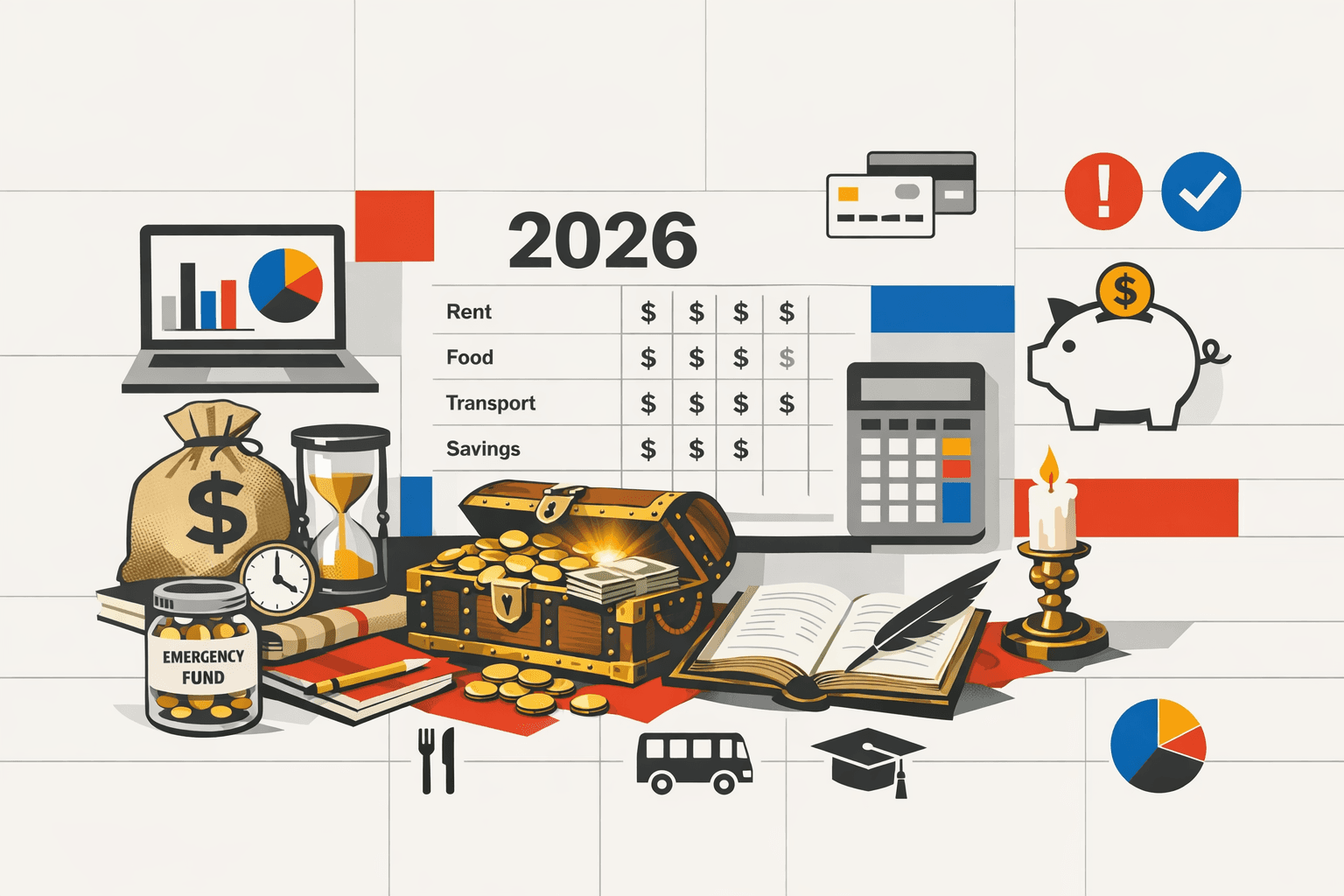
Budgeting for Students: A Realistic Monthly Budget Template for 2026
The average American college student graduates with $37,717 in student loan debt according to Education Data Initiative's 2026 report, and starts their professional career with limited savings and full adult financial exposure. The money habits formed during university years — good or bad — have a documented long-term effect on wealth accumulation in the following decade.
Student budgeting guides typically fail for one of three reasons: they assume financial literacy the student does not have, they use generic percentage rules that do not reflect actual student spending patterns, or they recommend tools that are too complex for someone managing classes, part-time work, and social obligations simultaneously.
This guide uses realistic student spending data, acknowledges that most student budgets are structurally constrained (not just behaviorally undisciplined), and focuses on the minimum viable system that builds lasting money habits without requiring hours of monthly financial management.
Key Takeaways
- Student income is structurally volatile: financial aid disbursements, part-time weekly wages, parental transfers, and seasonal gigs all arrive irregularly — the budget system must account for this
- The 50/30/20 rule is poorly suited to students: housing and food typically consume 55–70% of student income, leaving little for the "wants" and "savings" categories the rule assumes
- Tracking comes before allocating: students consistently overestimate how much they spend on food and underestimate how much they spend on small digital and convenience purchases
- Free student resources are significantly underused: student discounts, campus resources, and financial aid adjustments can recover $200–$400/month many students do not know they can access
- Building the habit infrastructure now — automatic micro-savings, receipt tracking, subscription audits — creates the behavioral capital that compounds over a career
Understanding the Student Financial Reality
Before writing a budget, understand the structural constraints that make student personal finance different from adult personal finance:
Income is irregular. Financial aid (loans, grants, scholarships) typically arrives in large lump sums at semester start ($5,000–$15,000 in a single transaction). Part-time work income is weekly or biweekly in small amounts. Parental support may arrive monthly. These three income sources have completely different timing, and conflating them into a single monthly income figure causes planning errors.
Fixed costs are high relative to income. The College Board estimates that after aid, the average student spends $15,000–$28,000 annually on tuition, housing, food, and transportation. For a student working 20 hours/week at $14/hour, take-home is approximately $1,000–$1,100/month. Fixed costs typically consume 70–80% of this before any discretionary spending.
Social spending is psychologically complex. Social participation has genuine value — it is investment in relationships, mental health, and professional networks. Student financial advice that tells students to eliminate all social spending is both ineffective and counterproductive. The goal is category awareness, not category elimination.
Digital subscriptions accumulate invisibly. Student-age spending patterns show the highest category for "surprised when I saw my bank statement" is digital subscriptions. Streaming services, cloud storage, gaming subscriptions, news paywalls, and app subscriptions combine to $60–$120/month for the average student — largely invisible as individual transactions but significant in aggregate.
The Student Budget Template
Student budget template
Build Your Monthly Student Budget
Enter your income sources and typical monthly spending — the template handles the math.
Monthly income (all sources)
Monthly expenses
Income Categories (Monthly View)
The first step is converting all income sources to a monthly equivalent — including large lump sums from financial aid.
Financial aid: Take your semester aid disbursement, subtract tuition and required fees (which are typically automatically applied), divide the remainder by the number of months in the semester (4–5). This is your monthly financial aid contribution to living expenses.
Example: $8,000 semester aid - $6,000 tuition/fees = $2,000 living aid ÷ 4 months = $500/month
Part-time work: Your average monthly take-home (net, after tax). If hours vary significantly, use a 3-month average.
Parental support: Monthly fixed transfer if applicable. If irregular, average the last 3 months.
Other (scholarships, grants, gig income): Monthly equivalent of all other income.
Total monthly income = sum of all above.
Expense Categories: Realistic Student Benchmarks
These figures are based on Bureau of Labor Statistics consumer expenditure data for 18–24 year-olds and NCES student expenditure surveys, adjusted for 2026 cost levels.
Fixed Essential Expenses (Non-Negotiable)
| Category | Budget Range | Notes |
|---|---|---|
| Rent / Housing | $400–$1,200 | On-campus: $600–$900. Off-campus varies enormously by city. |
| Food — Meal Plan | $200–$500 | If required by university; varies significantly by school |
| Health Insurance | $0–$200 | Often discounted through university student plans |
| Phone | $30–$80 | Family plans significantly reduce this |
| Transportation | $60–$200 | Student transit passes often $30–$60/month; car adds insurance, gas, parking |
| Utilities | $0–$100 | Often included in campus/dorm housing; shared off-campus splits vary |
Variable Essential Expenses
| Category | Budget Range | Notes |
|---|---|---|
| Groceries / Food (non-plan) | $200–$400 | Highly controllable; the highest-leverage discretionary category |
| Dining out / Takeout | $100–$300 | Social spending; set a weekly limit, not monthly |
| School supplies / textbooks | $30–$100 amortized | Annualized: $360–$1,200/year. Rent, buy used, or use library copies. |
| Personal care | $30–$80 | Toiletries, haircuts, etc. |
| Clothing | $20–$80 amortized | Thrift stores, second-hand apps dramatically reduce this |
Discretionary / Lifestyle Expenses
| Category | Budget Range | Notes |
|---|---|---|
| Entertainment | $50–$150 | Cinema, events, social activities |
| Digital subscriptions | $0–$80 | Audit first; most students have 4–7 active subscriptions |
| Fitness / Sports | $0–$50 | Campus gyms are often free or nearly free |
| Travel | $0–$200 amortized | Budget annually; divide by 12 |
| Miscellaneous | $50–$100 | Always allocate something; budgets without miscellaneous categories consistently underestimate real spending |
Savings / Buffer
| Category | Target | Notes |
|---|---|---|
| Emergency micro-fund | $25–$50/month | Even small amounts; target $500 by graduation |
| Sinking funds | $0–$50/month | For annual or semi-annual predictable expenses |
Information
Rather than the standard 50/30/20 rule, a more realistic student framework: 55% essentials (housing, food, transportation, phone, insurance), 30% lifestyle (dining, entertainment, subscriptions, personal care), 15% financial goals (savings, extra debt payments, buffer). This reflects actual 18–24 expenditure patterns rather than an aspirational framework designed for dual-income adults.
The Subscription Audit: Find $60–$120/Month You Forgot
Digital subscriptions are the highest-yield budget audit category for students — because the spending is invisible, recurring, and frequently forgotten.
How to complete a subscription audit in 15 minutes:
- Open your bank and credit card statements for the last 2 months
- Search for every charge under $30 — these are where subscriptions hide
- List every recurring charge you find: name, amount, frequency
- For each one: Have you used this in the last 30 days? If no, cancel immediately.
Common student subscription categories:
- Streaming video (Netflix, Disney+, Max, Hulu, Peacock, etc.) — students commonly have 3–5 active
- Music streaming (Spotify, Apple Music, Tidal) — student discounts typically cut these to $5.99/month
- Cloud storage (iCloud, Google One, Dropbox) — often unnecessary at student data volumes
- News and media (New York Times, Washington Post, etc.) — many offer free student access through university library databases
- Gaming and gaming services (PlayStation Plus, Xbox Game Pass, etc.)
- Productivity and software (Adobe subscription, Microsoft 365) — frequently available free through university licenses
The discovery is consistently surprising. In our internal data, users tracking subscriptions for the first time average 5.8 active subscriptions they could not name in advance. The average subscription audit reduces monthly subscription spending by $45–$85 through immediate cancellation of services not actively used.
Success
Most university library systems provide students free access to: New York Times, Wall Street Journal, academic databases (JSTOR, etc.), streaming media, and software licenses (Adobe Creative Cloud, Microsoft 365, statistical software, design tools). These benefits are underused. Before renewing any subscription, check whether your university provides the same service free.
Handling Irregular Student Income
The hardest part of student budgeting is the timing mismatch between large financial aid disbursements and constant monthly expenses. A $2,000 financial aid living allowance arriving in September feels like abundance. By December, it should still have $500 left. Without an explicit system, it typically does not.
The semester disbursement system:
When a financial aid disbursement arrives:
- Immediately transfer the semester's living allowance to a savings account. Do not leave it in checking. A large checking balance triggers spending behavior — the Diderot Effect of financial accounts.
- Set up an automatic monthly transfer from savings to checking equal to your monthly financial aid allowance.
- Treat the savings account balance as unavailable. It is next month's money, earmarked.
This converts an irregular lump sum into a predictable monthly income source — which is the format your budget is designed to manage.
For variable part-time income:
If your hours vary week to week, budget based on your minimum expected monthly income (the floor), not your average or expected. Surplus in higher-income months goes to the buffer or savings. This prevents the higher-income weeks from inflating spending that cannot be sustained in lower-income weeks.
The Minimum Viable Student Money System
Most personal finance advice recommends systems that require 30–60 minutes per week. Students — managing coursework, part-time jobs, and a social life — realistically have 10–15 minutes per week for financial management. The system must be designed for this constraint.
Weekly: 5 minutes
- Open your budget app or spending tracker
- Check: Is the week on track for your discretionary budget categories?
- Scan any receipts from the week that haven't been captured
Monthly: 20 minutes
- Review actual vs. planned category spending
- Identify any subscriptions or services that appeared unexpectedly
- Confirm the automatic transfers (savings, sinking funds) executed correctly
- Adjust the next month's budget if anything structural changed
Per semester: 45 minutes
- Process the financial aid disbursement using the system above
- Complete a subscription audit
- Review the previous semester's spending and identify the one category that most consistently surprised you
- Check whether your part-time income baseline has changed
This is the minimum system that produces meaningful behavior change. Below this engagement threshold, the budget becomes a document rather than a system — and documents do not change spending patterns.
Free and Low-Cost Tools for Students
Yomio (free tier): Receipt scanning with item-level capture. Particularly useful for students who spend heavily in grocery and food categories — the item-level detail reveals where grocery spending actually goes. No bank account connection required.
YNAB (student discount + free trial): YNAB offers a 12-month free subscription for current students with a .edu email address. The zero-based methodology is particularly suited to students who receive irregular income in large amounts — allocating every dollar of a financial aid disbursement before it is available to spend creates the structure that prevents lump-sum depletion.
Spreadsheet templates (free): Google Sheets and Excel both have functional student budget templates. Not the most frictionless option, but fully customizable and free. Appropriate for students who want full control of the structure.
Your university's financial wellness center: Many universities now operate financial wellness offices providing free counseling, budgeting workshops, and financial planning assistance. These resources are substantially underused and include access to certified financial counselors at zero cost.
Category-by-Category Cost Reduction Strategies
Food: The Highest-Leverage Category
Food (groceries + dining) is typically 20–30% of student spending and the most controllable major category.
Grocery strategies:
- Unit-price comparison (price per ounce) is more important than sale price; store-brand equivalents for non-perishables reduce cost 20–40%
- Weekly meal planning before grocery shopping reduces impulse purchases significantly (research from Journal of Consumer Research, 2023)
- Receipt scanning for grocery purchases reveals exactly what percentage of grocery spending is genuinely necessary vs. habitual — students who track grocery items at item level typically find 15–25% of grocery spending is snacks, beverages, and prepared foods they do not prioritize
Dining strategies:
- Set a weekly dining budget, not monthly — weekly limits are more psychologically salient because feedback arrives sooner
- Student meal deals and happy-hour restaurant specials in university neighborhoods are specifically targeted at student price points
- Cooking in bulk (batch cooking on Sundays) reduces weeknight takeout ordering, which is the highest per-meal cost category
Transportation
After housing, transportation is typically the second-highest-leverage single cost variable.
On-campus or walking-distance housing: Eliminates or radically reduces transportation costs. The premium for walking-distance housing is typically recovered in avoided transportation costs within 6 months.
Student transit passes: Most university cities offer heavily discounted or effectively free transit to students (UPASS, student transit programs). Check with your student services office — these passes often cost less than $100/semester and eliminate car-related costs entirely.
If you have a car: The full cost of car ownership includes insurance, registration, maintenance reserve, and fuel — not just the car payment. Total car costs for a student-owned vehicle typically range $400–$800/month. In walkable university cities, car ownership is often the single most significant optional expense.
Textbooks and Course Materials
Never buy new textbooks at list price. Options in order of cost:
- University library physical reserve (free, limited availability)
- Digital library access / Kindle Unlimited (free through library)
- Previous edition (often 95% identical to current, available for 1/10th the price)
- Peer secondhand (student Facebook groups, university textbook exchange)
- AbeBooks, ThriftBooks, eBay for used copies
- Chegg rental (lower-cost than purchase for single-semester textbooks)
Average list-price textbook savings using any of the above: $30–$100 per textbook, $300–$800 per semester for a full course load.
Building Good Money Habits Now Pays Off Later
The research on long-term financial behavior consistently shows that habits formed in early adulthood have disproportionate persistence. A 2024 study in the Journal of Financial Planning found that young adults who tracked spending consistently for 6+ months before age 25 had measurably higher savings rates, lower credit card debt, and better emergency fund coverage at ages 30 and 35, controlling for income.
The student years are the highest-leverage time to establish financial behavior — not because the dollar amounts are large (they are not), but because the habits and systems established now persist as income rises.
Building the tracking habit, the automatic savings habit, the subscription audit habit, and the monthly review habit while stakes are low means these behaviors are default rather than effortful when the dollar amounts become significant.
Track your student spending at item level — free
Yomio scans your receipts and shows you not just what you spent, but what you bought. Perfect for students who want to understand grocery and food spending without hours of manual tracking. No bank account connection required.
Download Yomio freeFrequently Asked Questions
Related reading
How to create a monthly budget that actually works
The full budgeting framework behind the student template.

How to stop living paycheck to paycheck
The transition framework from student budgeting to adult financial stability.

How to build an emergency fund
Even a $500 student emergency fund changes your financial resilience.